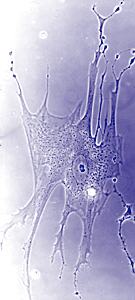
Examples of simple forms of segmentation that can be used with confocal data include thresholding and masking.
Thresholding involves limiting the intensity values within an individual image or the entire image stack to a certain bounded range. For example, confocal image corresponds to fluorescence intensity at a point within the specimen, the pixels with lower values represent areas with lower fluorescence while the pixels with higher values represent brighter regions. It may be decided that all pixels below a certain value do not contribute significantly to the object(s) of interest and hence can be eliminated. This can be done by scanning the image(s) one pixel at a time, and keeping that pixel if it is above the selected intensity value, or setting it to 0 (black) if it is below that value. In a similar manner, thresholding can also be used to eliminate non-consecutive ranges of intensities while preserving the regions containing the intensities of interest.
Masking is a procedure whereby an enclosed region(s) of
an image are defined for processing. This can be done either by manually
tracing around the regions of interest or by an automated routine. An easy
application of this is to use a 2-D stacked projection of an image to define
the image mask. The stacked projection of the image stack is a single image
that represents the sum of all of the images in the image stack. If the
object of interest has a closed, continuous surface the stacked projection
defines the absolute boundaries of the object in 2-D. A mask can be formed
by either manually tracing around the boundaries of the object(s) of interest
in the stacked projection or by absolute thresholding. The mask can now
be applied to the entire image stack, such that regions falling within
the mask selection area are preserved, whereas areas outside this region
are eliminated. After the mask has been applied, thresholding and image
filtering methods can be used to aid in removing the remaining undesired
regions.
Back to
Heading