Introduction
Laser Scanning Confocal Microscopy (LSCM) is now established as a valuable
tool for obtaining high resolution images and 3-D reconstructions of a
variety of biological specimens.
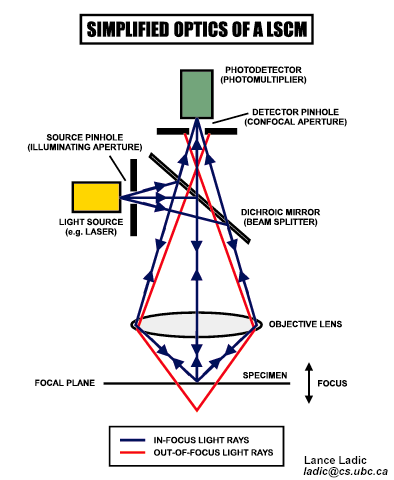 In LSCM, a laser light beam is expanded to make optimal use of the optics
in the objective. Through a x-y deflection mechanism this beam is
turned into a scanning beam, focussed to a small spot by an objective lens
onto a fluorescent specimen. The mixture of reflected light and emitted
fluorescent light is captured by the same objective and is focused onto
a photodetector via a dichroic mirror (beam splitter). The reflected light
is deviated by the dichroic mirror while the emitted fluorescent light
passes through in the direction of the photomultiplier. A confocal aperture
(pinhole) is placed in front of the photodetector,
such that the fluorescent light from points on the specimen that are not
within the focal plane (out-of-focus light) where the laser beam was focussed
will be largly obstructed by the pinhole. In this way, out-of-focus information
is greatly reduced. This becomes especially important when dealing with
thick specimens. The spot that is focussed on the center of the pinhole
is often referred to as the "confocal spot." A simple arrangement of a
LSCM illustrating the confocal priciple can be viewed.
In LSCM, a laser light beam is expanded to make optimal use of the optics
in the objective. Through a x-y deflection mechanism this beam is
turned into a scanning beam, focussed to a small spot by an objective lens
onto a fluorescent specimen. The mixture of reflected light and emitted
fluorescent light is captured by the same objective and is focused onto
a photodetector via a dichroic mirror (beam splitter). The reflected light
is deviated by the dichroic mirror while the emitted fluorescent light
passes through in the direction of the photomultiplier. A confocal aperture
(pinhole) is placed in front of the photodetector,
such that the fluorescent light from points on the specimen that are not
within the focal plane (out-of-focus light) where the laser beam was focussed
will be largly obstructed by the pinhole. In this way, out-of-focus information
is greatly reduced. This becomes especially important when dealing with
thick specimens. The spot that is focussed on the center of the pinhole
is often referred to as the "confocal spot." A simple arrangement of a
LSCM illustrating the confocal priciple can be viewed.
 A 2-D image of
a small partial volume of the specimen centered around the focal plane
(referred to as an optical section) is generated by performing a raster
sweep of the specimen at that focal plane. As the laser scans across the
specimen, the analog light signal, detected by the photomultiplier, is
converted into a digital signal, contributing to a pixel-based image displayed
on a computer monitor attached to the LSCM. The relative intensity of the
fluorescent light, emitted from the laserhit point, corresponds to the
intensity of the resulting pixel in the image. The plane of focus (Z-plane)
is selected by a computer-controlled fine-stepping motor which moves the
microscope stage up and down. Typical focus motors can adjust the focal
plane in as little as 0.1 micron increments. A 3-D reconstruction of a
specimen can be generated by stacking 2-D optical sections collected in
series.
A 2-D image of
a small partial volume of the specimen centered around the focal plane
(referred to as an optical section) is generated by performing a raster
sweep of the specimen at that focal plane. As the laser scans across the
specimen, the analog light signal, detected by the photomultiplier, is
converted into a digital signal, contributing to a pixel-based image displayed
on a computer monitor attached to the LSCM. The relative intensity of the
fluorescent light, emitted from the laserhit point, corresponds to the
intensity of the resulting pixel in the image. The plane of focus (Z-plane)
is selected by a computer-controlled fine-stepping motor which moves the
microscope stage up and down. Typical focus motors can adjust the focal
plane in as little as 0.1 micron increments. A 3-D reconstruction of a
specimen can be generated by stacking 2-D optical sections collected in
series.
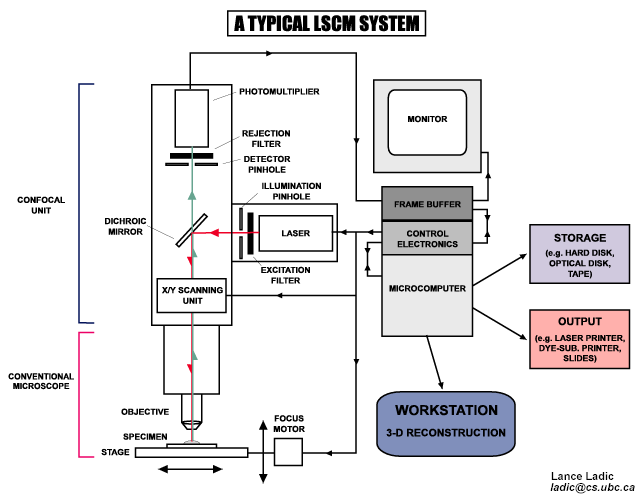
The general setup of an entire LSCM system is shown in this picture.
It should be noted that most laser scanning confocal
microscopes consist of a confocal unit attached to a conventional fluorescence
microscope.
 Back to Heading