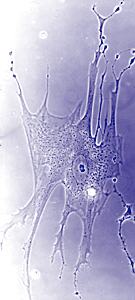
Median and Gaussian filters have the general affect of smoothing images. These are used to eliminate noise and background artifacts and to smooth sharp edges, but also tend to remove some of the detail in small objects.
Sharpening filters can be used to emphazise details in the image stack, but also have the effect of highlighting noise and other small artifacts. The application of sharpening filters is most useful when the image stack consists of fine structural components of a specimen, or when edge enhancement is desired.
The contrast and brightness of the image stack can be adjusted to enhance perception of the sampled specimen. This is usually done by changing the ramping of the grey scale values for the dataset. Histogram equilization can be used to improve contrast by a non-linear mapping of the grey levels in an image. This technique is most commonly used when the grey levels are concentrated in a small portion of the range of possible values.
It is important to realise that the application of filters
to the data set can ultimately affect quantitative measurements of 3-D
reconstructions produced from it. As such, the application of filters in
some instances are only used for display purposes, and quantitative measurements
are made on the unprocessed data.
Back to
Heading