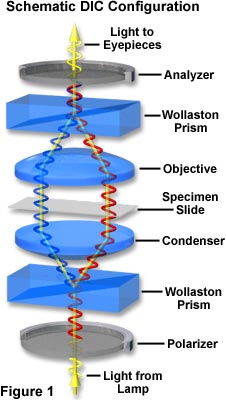
In transmitted light DIC, light from the lamp is
passed through a polarizer located beneath the substage condenser,
in a manner similar to polarized light microscopy. Next in the light path
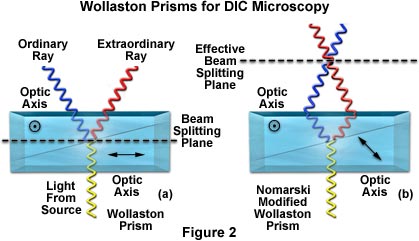
(but still beneath the condenser) is a modified Wollaston prism that splits
the entering beam of polarized light into two beams traveling in slightly
different directions. The Wollaston prism is composed of two quartz wedges
cemented together, from which emerging light rays vibrate at 90 degrees
relative to each other with a slight path difference. A different
Wollaston prism is needed for each objective of different magnification.
Wollaston prisms are usually loaded into a revolving turret on the
condenser, which allows the microscopist to rotate the appropriate
prism into the light path when changing magnifications.